R.O.A.D. Barbados Historic Handwriting Challenge
'/%3e%3c/svg%3e)
'%3e%3cpath fill='%23001489' d='M0 0v6h9V0z'/%3e%3cpath fill='%23e03c31' d='M0 0v3h9V0z'/%3e%3cg stroke='%23fff' stroke-width='2'%3e%3cpath id='d' d='m0 0 4.5 3L0 6m4.5-3H9'/%3e%3cuse xlink:href='%23b' stroke='%23ffb81c' clip-path='url(%23c)'/%3e%3c/g%3e%3cuse xlink:href='%23d' fill='none' stroke='%23007749' stroke-width='1.2'/%3e%3c/g%3e%3c/svg%3e)
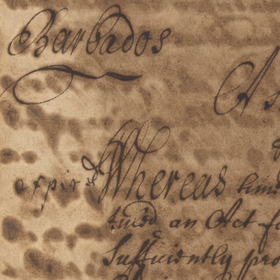
Barbados’ colonial-era history is preserved in thousands of handwritten pages - deeds, wills, estate inventories, census records, and other archival documents digitised through the Reclaiming Our Atlantic Destiny (R.O.A.D.) Programme.
These records hold powerful insights into lives, economies, families, and histories. But many are difficult to read at scale because of faded ink, degraded pages, and unfamiliar handwriting.
Your mission is to build a model that can recognise and transcribe historical handwritten text from scanned images. Think of it as building a digital historian: a model that turns irregular handwritten records into clean, machine-readable text for research, storytelling, and preservation.
To help you get started, we’ve also released an OCR Starter Pack.
The starter pack includes three independent OCR approaches:
- VLM – for high OCR accuracy and multimodal understanding
- Kraken-OCR – designed for historical and challenging documents
- Paddle-OCR – a fast, production-ready OCR pipeline
Each approach includes its own setup, environment, inference workflow, and evaluation scripts, so you can quickly test different OCR strategies and work towards your first submission.
This challenge is about more than transcription. Strong solutions could help unlock faster, more scalable digitisation of archival records - in Barbados and across other dispersed archives in the Commonwealth.
We’re excited to see how the Zindi community brings these historical records to life 🚀
Hi, I have a question about the compute and reproducibility requirements for top-performing solutions.
Are participants allowed to use very large open-source VLMs, such as 32B or 72B models, or ensembles that require multiple GPUs?
For top-10 code verification, could you please clarify:
This clarification would help participants choose models that can be reliably reproduced during final verification.